Showing posts with label Gold. Show all posts

18 Mar 2012

India's Union Budget FY 2013


The run-up to the Union Budget has seen a plethora of ‘experts’ (bankers, corporate executives, investors, economists, journalists, etc.) voicing their opinion of what the Union Budget FY2013 should look like. The Union Budget is probably the most hyped up event in the economic calendar. From being a simple event of the government declaring the profit and loss account of the public finances, it has undergone a metamorphosis, whereby the government now provides a snapshot of the nitty-gritties of the economy, policy ingredients, and guidance for the next fiscal year. Nobody gains from this parliamentary Budget session as much as the media. In fact, judging by the past few years, the Budget has been more of the TRP (Television Rating Point) event than a GDP (Gross Domestic Product) event.

 
Budget Day in India is somewhat of a close follower of the British counterpart. For many years in Britain, the Chancellor of the Exchequer ceremonially enters the House of Commons with a Victorian-era ‘budget box’ briefcase. In similar fashion, Indian Finance Minister Pranab Mukherjee clutched his red leather briefcase as he entered the Indian Parliament building. Mr. Mukherjee presented India’s 81st annual Budget on March 16th; Individually, it was his seventh, the second highest by any Finance Minister in India. Several ‘experts’ were hoping the budget would introduce the much-awaited reforms that would spur economic growth, and bring back the investor confidence. The key reforms anticipated by the markets included:
  1. A revamp of Tax-structure by introducing Goods and Service Tax (GST) and a Direct Tax Code (DTC)
  2. Allowing Foreign Direct Investment (FDI) in sectors such as Aviation, Retail, and Insurance
  3. Trimming the fiscal deficit
  4. Removing infrastructure bottlenecks
  5. Breakup of the state-run Coal monopoly
  6. Cutting back on subsidies (Fuel, Fertilizer, and Food)
  7. Maybe even some tax relief for the middle class

However, one doesn’t need to be a genius to realize that making everybody happy was impossible. The FY-2013 Budget, like most of its predecessors, stuck to the age-old trend of taxing consumption, raising taxes for existing taxpayers to pay for the handouts given to the impoverished, bail-out ailing sectors, and optimistically talk about reforms to come. The emphasis was on Inclusive Growth, with increased spending on agriculture, healthcare, and education. Little wonder that his choice of literary quote was from Hamlet: “I must be cruel, only to be kind”, compared to Dr. Manmohan Singh citing Victor Hugo in 1991, “a reformed and confident India was an idea whose time had come”.

The FM started his budget speech reminding everyone of the tough global economic environment (high oil prices due to tensions in the Middle East, European Crisis, the usual suspects really). Then he moved on to present India’s economic performance. FY2012 GDP growth rate pegged at 6.9%, compared to 8.4% in the previous year. GDP growth for FY2013 expected to be around 7.6%. Then he moved on to talk about fiscal consolidation, saying that issues regarding public finance – something that investors and the RBI have been demanding for quite some time now – would be addressed. The fiscal deficit, targeted at 4.6% of the GDP, was likely to be around 5.9% for the year ending March 2012. However, factoring in the states’ deficit, and off-balance sheet items, the overall deficit could touch 9%. He announced the target for next fiscal year to be 5.1% (and below 4% in 3 years), which would be achieved on the back of increased service and excise taxes, and subsidy expenditure reduced to 2% of the GDP (and 1.7% in 3 years) from about 2.7% now. It also set a divestment target of Rs 300 billion for FY2013 compared to its FY2012 target of Rs 400 billion, of which it only managed to raise Rs. 139.1 billion (through an FPO of Power Finance Corp. and a 5% stake auction on Oil &Natural Gas Corp.)

He also tried to excite the financial markets by proposing Qualified Foreign Investors (QFIs) access to Indian Corporate Bond Markets; and incentivize greater participation by retail investors in equity markets through Rajiv Gandhi Equity Savings Scheme, which would give them 50% income-tax deduction upto Rs. 50,000. Then he announced that small investors could e-vote in companies. Obviously their e-vote would not be sufficient to stop the Government from looting PSUs (Remember ONGC?). Furthermore, he lowered the Securities Transaction Tax (STT) to just 0.1%.

Mr. Mukherjee then moved on to talk about the bottlenecks in the economy:
  • Provided Rs 158.88 billion for recapitalization of public sector banks, regional-rural banks, and other financial institutions like National Bank for Agriculture and Rural Development (NABARD)
  • Allowed another Rs. 600 billion worth of tax-free bond issuances to fund infrastructure projects
  • Cut customs duty on imported coal to ensure fuel supply for power generation
  • Directed Coal India to sign long-term Fuel Supply Agreements (FSAs) with Power plants
  • Allowed Airlines to raise more foreign loans (ECBs) for Working Capital
  • Allowed ECBs for Capex Requirements of Infrastructure Projects (more specifically, power projects, roads and highway projects)
  • Set up a Credit Guarantee Trust Fund and allowed ECBs for Low-Cost Housing Projects to address shortage of affordable housing in many cities
  • Provided for Telecom Towers to get viability gap-funding
  • Increased funding for National Rural Health Mission (NRHM) to Rs. 20.8 billion
  • Announced a “White Paper” is being prepared to deal with on black money (illicit funds) stashed both, at home and abroad
  • Increased Defense spending by 17% to Rs. 1.93 trillion
  • Provided Rs. 255.55 billion to the Right to Education, a 21.7% yoy increase, and also proposed setting up a Credit Guarantee Fund for students

Finally he spoke about Taxes. On personal taxes, he enhanced the basic limit for tax exemption to Rs. 200,000, and expanded the 20% tax slab upto Rs. 1 million. The new tax slabs is illustrated below. Furthermore, there would be no separate tax slabs for women. Interest-income upto Rs. 10,000 from savings account in banks or post offices would now be tax-free. But custom duty on Gold and Platinum were increased (understandably so, to curb gold imports and to channel that money into more productive areas of the economy). Additionally, Sin tax increased on some tobacco products.
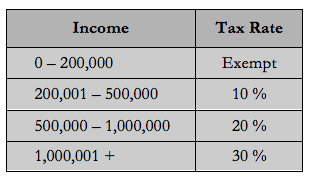

 There was no change in corporate tax rates. Broadly, service taxes and general excise duties were hiked to 12%. However, peak excise duty remains unchanged at 10%. This surely would be inflationary as services account for 59% of our GDP. I have compiled a chart to illustrate which goods or services will now cost more and which will cost less.


Overall, Union Budget 2013 was expected to deliver big-bang reforms. But all it had to offer was the traditional mix of more public spending and reshuffled taxes, none of which will be revitalize the stalled engines of economic growth. However, one announcement that was big bang in nature was that of General Anti Avoidance Rules (GAAR), a proposal to amend tax laws to retroactively levy capital gains tax on Indian assets (even on deals that take place abroad by foreign entities). This would apply to transactions as far back as April 1962. It appears that the amendment is principally aimed at taxing Vodafone, but this could well scare off foreign investors – the same people who fund India’s current account deficit; the same people that the Indian Government has been trying to woo.

Brief Background on Vodafone Case:

The British telecom giant bought an Indian operator from Hutchison Telecom of from Hong Kong in an offshore deal in 2007 for $11 billion. However, the Supreme Court of India, in January 2012, ruled that Vodafone should not have to pay a $2.2 billion tax that the Indian government claimed.

Later in the day, Mr. Mukherjee tried to explain that the government was only clarifying the 1962 tax law, and trying to close a loophole that allowed some companies to structure transactions in tax-havens such as Mauritius, purely to avoid paying any capital gains tax. “We are making it very clear that it is the law of the land — this is the intention of the legislature,” he said on NDTV, a news channel.


My Reaction
  
The Union Budget continued with the present Government’s theme of Inclusive Growth. Thankfully however, it refrained from announcing any extremely populist measures, especially considering its poor performance in recent state elections. Instead, it focused on fiscal consolidation. However, no big-ticket reforms were announced either. It seems like whatever additional revenues they’re raising will all be diverted to welfare programs and wasteful subsidies. So in short, our government continues to play Robin Hood.

The government has missed targets before. Furthermore, the last 2 quarters have seen so many revisions that government estimates can no longer be considered a reliable source. There is something really wrong with the way the official statistics are calculated and maintained. Hence pardon my cynicism but I’d take these Budget numbers with a pinch of salt too.

One major takeaway is that the government has missed an opportunity to deliver reforms and jumpstart the productive engines of the economy. I was not expecting the budget to deliver too much, but at least a few reforms were desperately needed. Politics is once again driving the nation at the detriment of economics.

We witnessed this two days ago as well, when a coalition ally Ms. Mamata Bannerjee, populist leader of West Bengal based Trinamool Congress, demanded the Railway Minister (who belongs to her own party) to be fired. 


His crime? Proposing a fractional rise in rail fares to modernize Indian Railways and improve its safety and hygiene. The rail budget was forward-looking, and the fare-hike was very modest, ranging from 2p – 30p per kilometer (or 0.04 – 0.6 cents per km); the fares had not been revised since 8 years. But by proposing this, Rail Minister Mr. Dinesh Trivedi had apparently “gone against the Trinamool Congress Party’s DNA” and that was unacceptable. Imagine their reaction if the government proposed privatizing the railways.

With such obstructing allies, it would be near impossible for the Congress to carry out any significant reforms even if they had a stomach for them. Another problem is that India Inc is a spoilt bunch that loves to sulk; hence business and investment climate will not improve until some policy action from the government. This budget failed to do that. The measures announced were marginal at best. It didn’t help RBI either. The central bank is terrified that inflation would pick up again, reflecting a host of supply-side constraints ranging from agricultural supply chain to inadequate infrastructure.

So what should the Budget have focused on? Even taking baby-steps, but in the right direction, can go a long way to fixing things. In addition to all that Mr. Finance Minister announced, he should have formed a Priority Group to maneuver the following:


  1. Raise diesel prices, incrementally and quietly, but offset that by matching cuts in the tax on diesel. That way, the fiscal hole starts getting plugged, and the consumers don’t feel much of a pinch.
  2. Set-up a facility to fast-track land acquisition and environmental clearances. This would kick-start the implementation of stalled projects, which would create employment along with boosting infrastructure, and housing markets, financial markets, and business sentiment – and all this without investing a single new penny.
  3. Present a draft on GST and DTC, outlining how the overall economy (include every stakeholder) would benefit from it. Start discussions with an established deadline for the rollout.
  4. As of now, India has only 790 diplomats and ambassadors, compared to about 3,000 in Brazil, over 6,000 in China, and well over 20,000 in America. While this may not have much of a direct impact on Indian’s finances (except their payrolls), it does increase India’s presence in different nations. This not only helps in economic ties, but also strategic ties. For a nation trying to strengthen its global footprint, India is severely under-represented on a diplomatic level.

In a separate post, I would like to share 2 open letters addressed to Finance Minister Pranab Mukherjee in response to his budget announcement. They sum up pretty well how some segments of the economy will be affected. A transcript of his BS (I mean Budget Speech) can be found here:

10 Feb 2012

Infographics


Browsing the web over the weekend, I came across some very interesting infographics, which I though I’d share here. While some of the data (statistics) featured may be slightly outdated, their relevance still remains. Also, for some people, the scope of information in this post would come as rather limited (to China, USA, and Europe), but then again, I'm not exactly writing a book here.

1. China in numbers - Very interesting compilation


2. Rise of the Giant - Tip of the Iceberg?


3. China's Wealth Gap - A natural byproduct of Capitalism?


4. China Online - China's very own Social Media Revolution


5. US / China Trade - Boon or Bane?


6. Where are American Jobs going? - At least unemployment isn't as bad as the 1930s


7. All the Gold in the World - Not enough to cover USA's National Debt


8. America's Digital Divide - Another interesting revelation


9.  USA v Europe - Who's more Productive? - Can you spot the Irony.


10.  European Debt Debacle - A snapshot

 
11. Europe's Crisis - The Complete Picture


12.  Europe's Crises - Role of the European Central Bank


Well, that was Fun! 
And Informative too. 
Maybe I'll do a similar post focusing on India (If I can find good material).
Watch this space...

(Disclaimer: None of the above infographics are my own creation. I am merely sharing them here as they are neat sources of information)

12 Jan 2012

Fate of the US Dollar - Greenback making a comeback?


After looking back at the events that shaped and defined 2011, a follow-up post on previewing 2012 ought to have been natural progression. But considering the way that the US Dollar has defied all economic theories in 2011, I think it deserves to be the focal point of 2012’s first post.

Background

In August 2011, for the 1st time in history, rating agency Standard & Poor’s downgraded the long term rating of the United States of America from AAA to AA+ on the back of “Political Risk and Rising Debt Burden” and maintained the “Negative Outlook” which they had announced earlier in April. The announcement came 3 days after the US Congress voted to raise the Debt Ceiling of the Federal Government by the means of Budget Control Act 2011. This flag of caution was mostly ignored as the other 2 major rating agencies (Moody’s and Fitch) maintained their superlative ratings. However, Moody’s had lowered its outlook to negative in June, and Fitch too did the same later in November. The S&P had already lowered their outlook earlier in April, sending the Dollar to a 3-year low within a couple of weeks.

The blame game started practically immediately after the announcement. President Barack Obama blamed the Bush Tax-Cuts (which he had actually extended). The Republicans blamed the liberal Democrats for out-of-control entitlement spending, and demanded Obama to seek US Treasury Secretary Timothy Geithner’s resignation. Meanwhile the Democrats blamed the Tea Party Movement for provoking the idea of US Defaulting on their Debt. The Independents blamed everybody.

But then...

It was not the 1st time that the USA’s National Debt had formed headlines. Since the 2007-08 Crisis, America’s economic recovery had not exactly been remarkable; neither had they drastically reduce their debt. In fact, at over $ 15 Trillion, the US Debt is already 100% of the GDP. Also, at sub-2% GDP growth, economic rebound has been abysmal. And yet, the US Dollar has shown tremendous resilience, and surprisingly perceived by investors as the safest haven for their money. This is not because the USA did something right, but because the rest of the world, chiefly Europe, got several things wrong. And when talks of Greece defaulting on their debt, and Europe going into a recession surfaced, it was the panic among risk-averse investors that drove them back into the Dollar. Now brokerages and some pundits are suggesting that the trend could continue and the Dollar could dominate most of 2012. However, I am still not convinced about the prospects of the Dollar, and once again, would prefer to take a contrarian stance. Let me throw some light on the dynamics that give method to my madness.

A strong US Dollar actually hurts export growth thereby expanding the trade deficit. This is bad news as it hurts American competitiveness in the modern age where, thanks to globalization, consumers have the choice to buy Asian, European or American products. This is the last thing America needs as its economic recovery struggles to gain momentum. This is the reason why the US and Europe have been so vocal about the Chinese Yuan being artificially undervalued apparently. More recently, the US Treasury even criticized Japan for trying to weaken the Yen. So it’s fair to say that the US Treasury is closely monitoring the impact of a stronger Dollar.

If there was one single most influential event that triggered the flight to the Dollar, it would have to be the Euro-zone’s Sovereign Debt debacle. To summarize the entire EU shipwreck in a jiffy, it was simply a case of too much reckless spending by Greece, funded by debt (as it always is), mostly issued by France and Germany. Since participation in the EU required fiscal and monetary discipline, the Greek government kept this mountain of debt a secret, and misreported the nation’s official economic statistics, until the truth finally emerged in 2010. This was the point where the concerns regarding a sovereign debt crisis in Europe, especially the PIIGS (Portugal, Ireland, Italy, Greece, and Spain) got louder, and the markets started losing confidence. Hence as the sentiments in Europe got jittery, because of disappointing bond auctions in August, and then Greek bondholders having to take a haircut in October, investors flocked to the Dollar for Capital Conservation.

However, by the time 2012 draws to an end, two possible scenarios could transpire: (a) the Euro-zone resolves their problems and has a concrete plan of action in place (perhaps over-optimistic) or (b) the European Union could either dissolve or expel the troubled nations (most possibly Greece). But the truth is that both those scenarios are extremes and unlikely to materialize. But either way, the one thing that is certain is that the Dollar will see an exodus of capital flowing into either a resurged Euro or a successor to the Euro (especially with Germany’s backing) in the 2nd half of 2012.

The Euro-zone troubles led to some resurgence in the US Dollar. But in the grand scheme of things, there has been a secular shift away from the dollar – both as a reserve currency as well as a trading currency. These are the two essential roles that the Dollar plays in the modern, globally entwined economy, and with those roles reduced, the Dollar will surely lose its supremacy. Let’s take a closer look at what’s happening on these fronts, starting with the USD as a reserve currency. China and Japan are the largest holders of US Treasury Debt (Look at the figure for USA’s foreign creditors). As of August 2011, over 60% of China’s $ 3.2 Trillion foreign exchange reserves were denominated in US dollars (including $1.1Tn in US Treasury Bonds). However, according to Standard Chartered Bank, while China’s reserves grew by $200bn in the 1st four months of 2011, 75% of this comprised of non-dollar denominated assets. China also bought Euros in 2011 in the form of sovereign debt from countries like Germany, France, Italy, Portugal, Spain, and Hungary, thereby adding to their previous European holdings. Chinese Premier Wen Jiabao declared that as long as Europe is serious about resolving its issues, China would continue to help financially. In addition to purchasing sovereign bonds, Chinese investments in European corporations too have grown phenomenally as they bought corporate bonds worth $72bn in the 1st half 2011 alone. 


And that’s not all. China has steadily been accumulating Gold reserves too. While its Gold holdings are only 1/8th of America’s, it’s steadily rising. China’s share of global Gold demand has tripled in the last decade from 6% in 2000 to 18% in 2010. And considering it is still only the 6th largest holder in the world with 1,054 tones, which accounts for less than 2% of its total reserves, it is expected that China’s hunger for this yellow metal is all set to rise. China’s not alone in the Gold rush. Other countries too bought gold in 2011 in an attempt to diversify their reserves. South Korea bought 40 tonnes, Mexico 98 tonnes, Russia 63 tonnes and Thailand bought 53 tonnes. Other countries that added gold to their national reserves include Columbia, Bolivia, Kazakhstan, and Venezuela. India’s central bank RBI made an early move, buying 200 tonnes in October 2009 from the IMF. Furthermore, according to estimates from World Gold Council, Indian households bought another 1,059 tonnes of gold between Sept2010 and Sept 2011, taking the aggregate Indian household holdings to 18,000 tonnes. The 2 illustrations below show which countries have the largest gold reserves, and how much does gold account for. 


China and India aren’t the only ones diversifying their reserves earnestly. Japan too has been following suit as its Finance Minister Jun Azum raised concerns about Japan’s $1.3 Trillion foreign reserves being dominated by US dollar denominated assets. In December 2011, when Japanese Prime Minister Yoshihiko Noda visited China, he announced buying Yuan Bonds worth $10 billion, and also agreed to use Yuan for bilateral trade with China. Furthermore, it also entered into a $15bn currency swap agreement with India recently. The agreement would give India 15 billion dollars to meet its short-term liquidity needs, and Japan would get Indian Rupees to trade with India directly and diversifying reserves at the same time.

China has made it no attempt to hide its ambitions of the Yuan replacing the Dollar as the world’s next reserve currency, and is not only slowly expanding Chinese bond markets, but also making bilateral trade agreements especially with its Asian partners, promoting Yuan denominated trade. It is expected that as the Hong Kong based Dim Sum Bond Market grows in market-capitalization (current m-cap is 35 billion), more countries & corporations will take notice and participate. Already having signed deals with Thailand, Japan and Pakistan in 2011, China is now well on its way to materialize its plans of signing an agreement with the 10-member Association of South East Asian Nations (ASEAN) to settle bilateral trade in the Yuan. The trading bloc is collectively China’s 3rd largest trading partner, and promoting Yuan settlement with them would be a major step in the dragon nation’s long term campaign to make its currency widely-used beyond its own borders, and take up a bigger role on a global stage. According to the Wall Street Journal, the Yuan accounted for less than 1% of China’s trade in 2010, but that number rose to more than 10% in 2011 and is expected to rise to 15% of the total trade in 2012 according to estimates from Deutsche Bank. China has been doing this (signing currency swaps to facilitate Yuan denominated bilateral trade) since the crisis period of 2008. In the graphic below, I highlighted the nations that China has signed such deals only in the last 2 years. As expected, the countries with closer geographical proximity have already been taken on board, and it would be little surprise that within another 2 years, more nations will follow suit, and this graphic will have more shades of red. Hence, in this backdrop, one would have to be very sanguine to maintain a rosy outlook of the dollar. 


Case for the Dollar

Having said all the above, it would be very naïve to write the US off so easily. A strong US Dollar does provide some benefits too. 1st of all, cheaper imports could help boost consumption in America. This rationale often attracts criticism that “Made in China” goods are the root cause of the USA’s deficit, but if an economic paper released by Federal Reserve Bank of SanFrancisco is of any merit, then that criticism is flawed because 85% of every Dollar spent by Americans on products “Made in China” benefits America, while China only gets 15% of the benefits. How? This is because the actual cost of production of those goods is under 15% of the final price that the consumers are charged, and the rest of the costs come from services such as transportation, logistics, retailing, marketing, etc. which are all done within America. However, since the masses do not realize this when they see a “Made in China” label on their goods, and also since 2012 is an election year, one should expect Washington to make politically popular decisions at the expense of prudent economic ones (call it if you want, business as usual).

Some people aren’t as cynical as myself and believe that the USD is indeed the safest best. Investment bank Morgan Stanley recently called the US the “best safe haven “and forecasted that the USD will get stronger in 2012 as deleveraging will cause balance sheets to shrink not only in Europe but around the world. According to another investment bank UBS, US fund managers, who collectively hold $40 trillion in US Dollar assets, and are 1 of the 3 largest holders of the US dollar (other 2 groups being sovereign wealth funds, and foreign central banks), have now stopped diversifying their portfolios. They are now planning on repatriating funds if the US equity markets continue to out-perform its peers.

Albeit at the expense of exporters, a stronger dollar benefits the consumers at some levels as it makes their imported discretionary expenditure items cheaper. However core expenses such as food and housing remain unaffected. Furthermore, cheaper imported raw materials are also a boon as it lowers input costs of production. However, this may not be useful at a time when business confidence and capital expenditure are low, and unsold inventories are already quite high. It should be noted that another implication of cheaper imports is that the country’s trade deficit widens. So I personally think that a stronger dollar, while benefits consumers at some levels, actually hurts the economic productivity of the country. Some companies would relocate their manufacturing base overseas to gain from lower labor costs and cheaper raw materials thereby maintaining healthy margins. This relocating however causes job loss in America (and no jobs means no income, which means no discretionary expenditure, which makes the cheaper imports fruitless).

Finally, a stronger dollar gives the US an opportunity to pay off some of its national debts at a favorable exchange rate. However, this opportunity comes at a time when conflicting political beliefs may make it impossible to make the most of it. As we all know, 2012 is an election year for the US, and any decision made by the Obama Administration, whether good or bad, will be shredded by the Republicans in the Senate, much like they rejected the American Jobs Act a few months ago.

So to conclude, while many pundits are getting bullish on the dollar, I want you to base your own stance on secular, longer-term trends and filter the short-term hullabaloo. And that secular trend is pointing towards a shift of economic power from the West to the East, and there is no better manifestation of this than the descent of the greenback.